
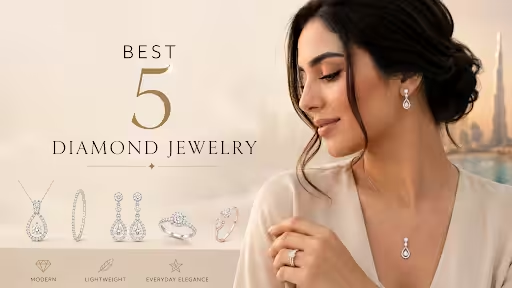
There’s a specific kind of jewelry box that exists in almost every UAE home. You know the one. Deep red velvet lining, a full matching set inside — necklace, earrings, bracelet, ring — all bought together, all worn exactly once at a wedding, then wrapped back up and forgotten for the next two years.
Nobody talks about it, but everyone has it.
And slowly, quietly, women here are done buying that box.
That’s not a criticism of traditional jewelry — gold and diamonds carry real meaning in this part of the world, culturally and financially. But there’s a difference between valuing fine jewelry and buying the same format your mother bought because that’s just what you did. The women buying diamonds in the UAE right now are asking a different question: will I actually wear this?
The answer is reshaping what sells.
1. The Solitaire Ring — Rebranded, Reworn
For the longest time, a solitaire diamond ring meant one thing here: engagement. You didn’t just buy one for yourself. That was the rule, unspoken but very much followed.
That rule is gone.
Women in their late 20s through their 40s are buying solitaire rings — single stone, thin band, nothing extra — and wearing them to work, to brunch, to the grocery store. Not as a statement. Just as something they like having on their finger.
The design logic is simple. One well-cut diamond on a clean gold band is harder to dress wrong than almost any other piece of jewelry. It doesn’t compete with your outfit. It doesn’t require matching earrings. It just sits there looking expensive and considered.
In a city where the professional environment demands a certain level of polish, that kind of effortlessness works extremely well.
2. Tennis Bracelets — And Yes, Everyone Really Is Wearing Them
Look, this one isn’t a secret anymore. If you’ve been to any gathering in Dubai over the past year — a birthday dinner, a work event, someone’s baby shower — you’ve seen at least three tennis bracelets in the room. Probably more.
The reason they’ve caught on so hard here specifically is the stacking culture. UAE women have always worn multiple bracelets together — gold bangles, thin chains, charm pieces. The tennis bracelet slides into that stack as the anchor without disrupting the whole thing. It adds sparkle without changing the vibe.
It also travels well between occasions. Wear it with a blazer on a Wednesday, wear it with an abaya to a family dinner on Friday. It doesn’t care.
3. Fancy-Cut Diamond Studs — Because Round Is Getting Predictable
Round brilliant studs are fine. They’re reliable. They photograph well. There’s nothing wrong with them.
But they’ve also been the default answer for so long that buying a pair now feels like ordering the same thing off the menu every single time just because you know what it tastes like.
UAE women — particularly those who already own a pair of round studs — are going back for a second pair in a completely different cut. Oval. Marquise. Emerald. Pear.
The emerald cut in particular has developed a quiet following here. It doesn’t sparkle the way a brilliant cut does. Instead it flashes — deep, broad flashes of light that feel more sophisticated than dazzling. Women who wear them tend to describe it as the difference between looking dressed up and looking put-together. Small but real.
Pear-shaped studs worn point-down are another strong choice, especially for women who find traditional chandelier earrings too heavy or too loud for regular use. Same drama, fraction of the weight.
4. Layered Diamond Necklaces — Built, Not Bought
This is the one that breaks most clearly from the traditional set mentality, and it might be the most interesting shift of all.
Instead of buying one large necklace designed to anchor a matching set, women are assembling their own combinations. Two necklaces, sometimes three, each at a slightly different length — maybe a fine diamond tennis chain sitting close to the collarbone, a longer chain with a small solitaire pendant, and occasionally a third with something geometric or minimal.
The result doesn’t look like something you picked off a shelf. It looks like something you built over time, which is exactly the impression it gives.
There’s also a practical angle here that nobody really discusses: one large traditional necklace at a high price point only works with certain outfits and certain occasions. Three smaller pieces at the same combined price point work separately and together, which is objectively better value — and UAE women who buy jewelry seriously have started doing that math.
5. Mixed-Metal Diamond Rings
Yellow gold isn’t going anywhere in the UAE. It’s too embedded in the culture, too connected to how jewelry value is understood here. But the insistence on single-metal pieces — all yellow or nothing — has softened considerably.
What’s replaced it is something more considered. A diamond ring with a white gold or platinum setting but a yellow gold band. The white metal around the stone makes the diamond look brighter and cleaner. The yellow gold band keeps it warm and familiar. For women who grew up with yellow gold but are drawn to how diamonds look in cooler settings, this split works perfectly.
Rose gold with pavé diamonds is also having a proper moment. The combination reads romantic without being delicate, which is a harder balance to strike than it sounds.
So What Does This All Mean?
It means UAE women aren’t buying jewelry differently because they care less about it. They’re buying differently because they care more — more about wearing it, more about it fitting into their actual lives, more about making choices that make sense for them specifically rather than choices that follow a format.
The traditional full set isn’t dead. It still gets bought. It still gets worn. But it’s no longer the automatic answer when a woman decides she wants to spend serious money on diamonds.
The automatic answer now is: what will I actually reach for tomorrow morning?
That question is changing everything.