
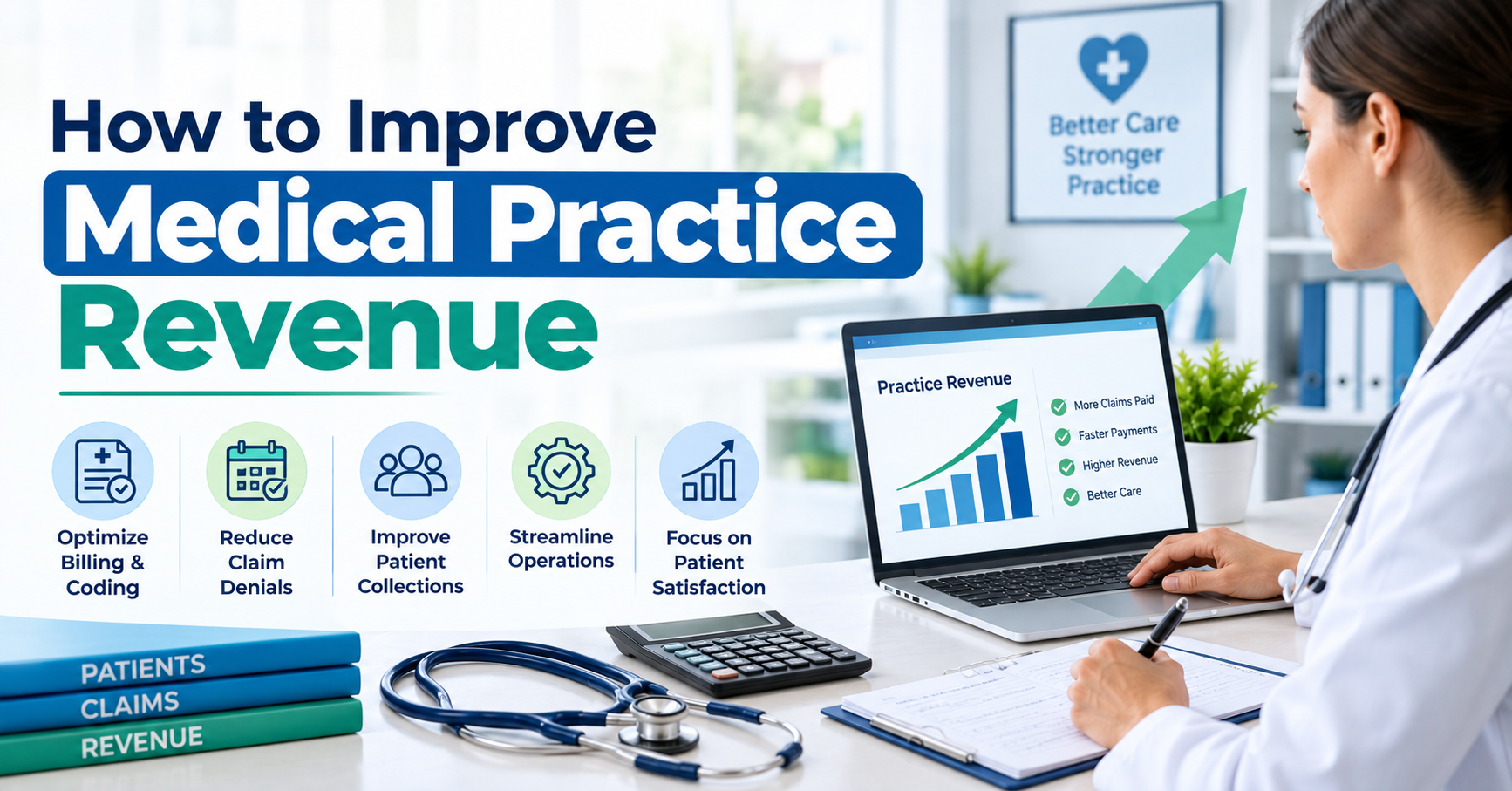
Operating a medical practice involves more than just satisfying the patients and delivering quality services. There is also a need to ensure that the money earned by your practice makes its way back into your hands. The main problem is that money may leak out for various reasons, such as rejected claims, late payments, and basic billing errors.
The good news is you don’t need a large number of patients to improve revenue. Closing some loopholes in your current process may do the job. Let’s look at the practical areas that can help you collect more of what your practice already earns.
Where Does a Medical Practice Lose Revenue?
A medical practice doesn’t lose its revenue due to one big blunder. It happens because of a series of small errors made daily. There could be some mistakes in billing forms, patients might not pay their balance, a scheduled appointment could be left unattended, or a payment could be pending.
Individually, all those mistakes could appear insignificant. But when there are hundreds or even thousands of appointments per month, then there’s going to be a considerable discrepancy between the treatment services you deliver and the revenue you actually earn.
Can Better Billing Processes Increase Practice Revenue?
Good billing allows you to get the maximum revenue that your practice has already earned. This does not require an increase in patient volumes. US healthcare rcm may assist practices in handling their billing, claims, collections, and other revenue processes better.
Where Do Billing Problems Usually Begin?
There are many times when billing problems originate even before claims are made. Inadequate patient data, wrong insurance data, or even coding errors can be potential sources of problems during the billing process.
It does not really require much work on their part for a pre-submission audit to solve the problem. This is not something that makes life difficult for the employees.
What Makes a Billing Process More Efficient?
An effective billing process will allow you to see the pathway that your team needs to take from the time that the services were delivered to the time the payment was finally received. If all the processes are clearly identified in terms of responsibility, then it will be easy to detect any problem and prevent it from causing more delays.
What Should You Do When Claims Are Rejected?
A stronger billing process should therefore include:
- Checking claims before submission
- Tracking rejected and denied claims
- Following up within a defined timeframe
- Identifying repeated reasons for rejection
- Correcting the underlying problem instead of repeatedly fixing individual claims
Can Technology Manage Revenue More Efficiently?
Yes, especially if the information is split across various software applications. With practice management technology, all the tasks that you perform in your day-to-day practice as an administrator will be put together in one, including scheduling, patient management, billing, payments, and reports. The advantage of using technology in this case is access to more relevant information.
What Can a Practice Management System Track?
A practice management system helps healthcare providers streamline daily operations through practice management services in USA, making it easier to collect data that would otherwise be scattered across different processes. Your team can track important information, such as:
- Patient appointments
- Billing and payments
- Outstanding balances
- Claim status
- Cancellations and no-shows
- Financial reports
This way of collecting all the information at once could help you recognise patterns better than looking through separate records.
How Can You Cut Down Unnecessary Appointments?
Your practice will be able to cut down on unnecessary appointments through:
- Sending out appointment reminders
- Making it easy to cancel an appointment
- Analysing the recurring no-shows for each patient
- Having suitable short-notice appointment slots
- Identifying the appointment types with the highest absences
Also, with these methods, you are going to be able to detect if there are any common trends for your missed appointments based on certain dates and certain patients.
Why Do Patients Miss Appointments?
No blame should be laid upon the patient. As indicated by studies, there are several main reasons why one might fail to attend an appointment at the general practice, such as forgetfulness, work-family engagements, and transport issues.
Knowing the reason will definitely help to determine the way out. Reminding might be helpful if the reason was forgetfulness, while offering more options for cancellation will help to determine when one cannot attend the appointment.
Which Financial Numbers Should You Track?
Revenue improvement becomes much easier when you know exactly what is happening. Instead of looking only at total monthly revenue, track a small group of useful measures:
| Metric | What it tells you |
| Collection rate | How much billed revenue is actually collected |
| Denial rate | How often claims fail to receive payment as submitted |
| Outstanding balances | How much money remains unpaid |
| No-show rate | How many scheduled appointments are not completed |
| Days in accounts receivable | How quickly billed money is collected |
Why Should You Track These Numbers Regularly?
This information may help you spot some issues that will not be visible through the revenue alone. For instance, even though revenue is constant, outstanding balances are increasing.
Regular review of such information provides a much better understanding of where delays and losses are occurring in payments in your practice. It also allows easy comparison with previous periods instead of having just the monthly revenue figure.
How to Increase Revenue Without Hurting Patient Trust?
Improving revenue must come from eliminating waste and ensuring proper billing, rather than treating the process of care like selling.
Look at the patient experience from scheduling to the final billing process. Each additional step or paperwork that doesn’t add value is another obstacle for the patient and the office.
How Does Better Process Benefit the Patient?
Process improvement helps not only the patient but also the staff because the process may be simplified to make things easier for both of them.
The patient receives more communication from their side, while the staff stops wasting time searching for information and correcting errors that could have been prevented easily.
Through simplification of processes, the process of scheduling becomes easy, the billing becomes straightforward, and communication is made constant. This will all help revenue without putting the patient through financial pressure.
Where Are the Process Changes Needed in a Practice?
Most often, the greatest improvements come from changes that are practical in nature, fewer errors in billing, more effective use of appointments, more timely follow-up, and better financial record-keeping.
There is no need to change all processes immediately. A practice can focus on those that cause revenue losses right now.
Readers Usually Ask
What is the quickest way for medical practices to increase their income?
The very first thing to do here is identify where your practice loses money now. It might be claim denials, outstanding balances, missed appointments, etc.
How do billing errors impact your practice revenue?
Billing mistakes can affect your income in terms of delays in payments.
Can technology help reduce revenue leakage?
Sure, the correct use of technology will allow for better control of the appointment process, billing, payments, and reports. But at the same time, you need correct information and procedures.
Is it better to get more patients or collect more efficiently?
Both methods can contribute to the practice’s development, but fixing the revenue leakage process can help your practice increase income without adding new patient load.
In Conclusion!
The additional funds that can be realised at your medical institution are not generated by just admitting more patients into your facility. By improving scheduling, claim submission, patient billing, and follow-ups, you will increase your institution’s revenue.
Identify the areas where the institution is prone to losses, and analyse the claims, scheduling, billing, and accounts of the institution. Once you have identified the weaknesses of your institution, you will address them and generate more income.