Let’s get this straight. You have written a commendable piece for your thesis. Polished the citations. Have revised it several times, and it contains no mistakes. Got the approval from your supervisor. Even received positive feedback from the committee. Even started considering publishing it. And then comes the question right at the finish line. The paper weight and binding grade. It sounds boring and not trivial at all, right? But what if we tell you that submitting your dissertation in the wrong format can actually delay your graduation? Now, it doesn’t sound that unnecessary, right? If we talk about the universities in Ontario, they consider these fragments way too seriously. So, how to avoid this last-minute panic situation?
Why the Physical Presentation of a Dissertation Symbolises Academic Integrity?
You will find many thesis editing services Toronto that will make every possible effort to polish your hard work. At such a crucial time, students do not give much notice to the physical presentation of their work. But universities across the globe, including in Canada, have very strict guidelines regarding paper weight and binding grade. Sometimes negligence towards the leads leads to delays in your graduation, and honestly, nobody wants this.
Your thesis is not just an assignment. It’s your academic record. And records need to hold longer. It should withstand repeated handling, long-term storage, and environmental changes. Cheap paper, yellowing, weak binding, and ink bleeds compromise the integrity of the document and the credibility of the archive. At this point, aesthetics do not really matter. It’s more about the longevity.
Ontario universities follow very similar archival principles, often inspired by Library and Archives Canada guidelines. The exact wording and lettering format differ between institutions, but if we talk about paper and binding weight and quality, they are mostly consistent. If we elaborate more clearly, it means that if you meet the proper standards for strong archival, it’s very likely to be accepted. Regardless of the place you are submitting, whether it is Toronto, Ontario, Ottawa, or elsewhere, there are high chances of your paper being published.
The General Requirement of Paper Weight
Most students, when they consider the paper weight element focuses on whether the paper is good or not. But in the context of the final archival copies, a regular printer is definitely not good enough. Before contacting the journal publication services Toronto for your thesis, make sure the physical copy is great and has no flaws.
The minimum acceptable paper weight across all the universities is 16 lb bond (60-65 g/m2). In Canada, for final universities and campus binders, 20 lb bond ( 75-80 g/m2) paper is mostly preferred. It provides better opacity and durability, and is excellent for long-term preservation. The paper should be clear, white, and speckles free. For libraries and permanent storage, acid-free or archival-quality paper is recommended. Acid-free paper resists yellowing and deterioration over time. It’s designed to last decades, not years. Libraries care deeply about this because once a thesis is archived, it may never be replaced. If you’re unsure, choosing a high-quality, white, acid-free 24 lb paper is rarely a mistake, especially if you’re planning to submit to universities in Ontario.
Also, do not go for textured or decorative papers at all. They even look elegant, but they interfere with scanning, digitising, and photocopying. Your dissertation will be referenced for years, and you do not want any possible flaws to appear even after years. At this point, being boring with white paper is way preferable.
Single Sided or Double Sided? Which Printing Mode is Better?
Before discussing this part, let us remind you that all these standards are made based on institutions. And almost every university follows the same convention. A few of them advised their own standards to the students. Nowadays, electronic ( PDF) submission is a preliminary requirement for many universities in Ontario. Still, many of them asked for the physical copies for the completion of their degree as well.
Now comes the part, the printing mode. For archival purposes, single-sided printing is mentioned in many university thesis guides in Canada. It reduces ink bleed-through and makes preservation of the dissertation easier. Double-sided printing is mostly requested for non-archival or departmental copies.
What is Binding Grade? A Breakdown With Reference to an Archival Dissertation
If you think binding grade is the same as the binding style, then you are a bit confused here.
Ensuring your dissertation can withstand decades on a shelf with the highest level of book binding is what binding grade actually means. Before going into the specifics about whether you need a hardcover or a softcover, you have to keep in mind that,
- Your binding must hold pages securely without loosening.
- It should lie flat without damaging the spine.
- It can withstand frequent handling and does not loosen at all.
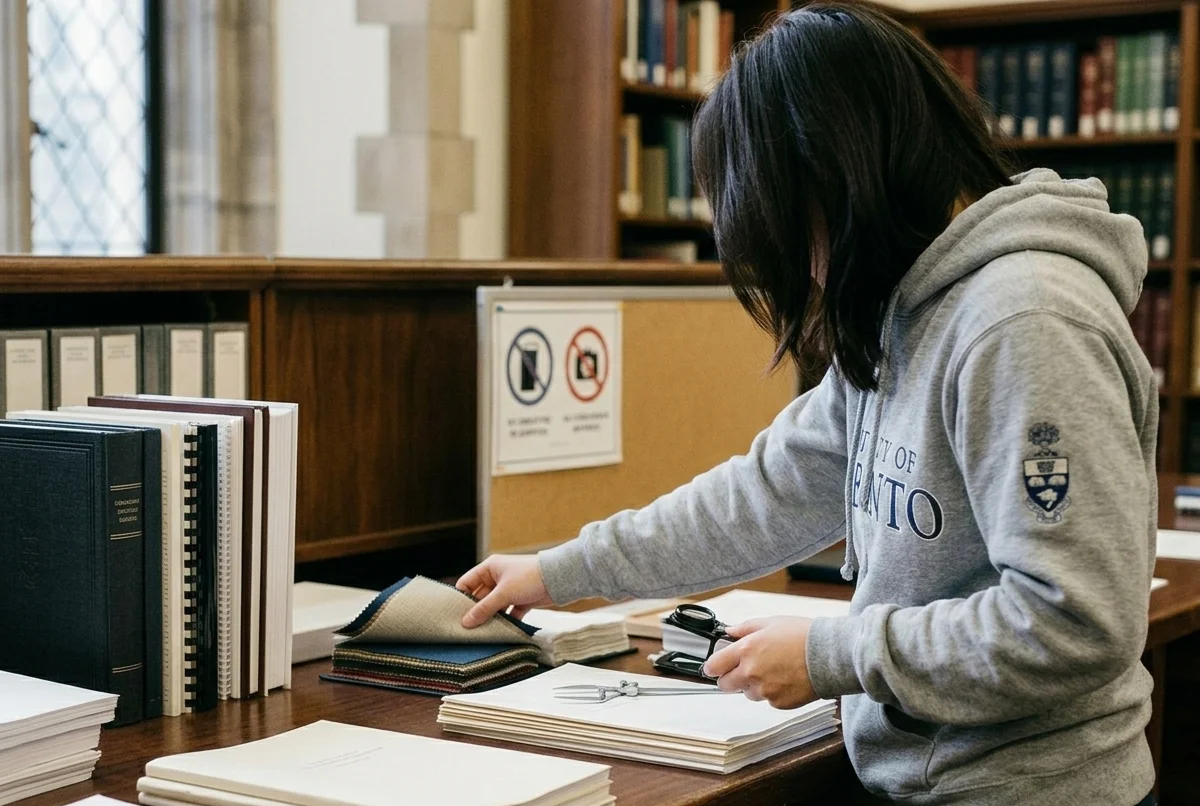
This is the reason why students must consider reliable and professional dissertation book binding services to avoid any possible mishaps. Going for simple spiral or comb binding does not guarantee a final archival submission.
Binding Types Preferred In Ontario Universities
Just keep this in mind:
- Archival Submission – Hardcover Binding
- Personal use – Softcover Binding
For the acceptance of the dissertation for archival in universities in Ontario, it must be considered that it has sewn or adhesive binding. The covers should be rigid. Typical colors include Maroon, Navy Blue, Black, or Dark Green. The lettering on the spine should be in gold or white, depending on the case.
FAQs
Is acid-free paper a mandatory requirement in all Ontario universities?
Most of these universities, for archival purposes, require acid-free paper for your dissertation. It is not quite mentioned, but it’s a basic standard for submission.
Which paper is acceptable? 20lb or 24 lb?
Some institutions allow 20 lb as the final weight for paper. But the safest choice is 24 lb because it is more durable and long-lasting.
Can I go for spiral binding for the final submission?
Usually, no. The spiral binding is not durable for archival purposes and can loosen within months.
Does binding affect journal publication later?
No. Proper dissertation book binding does not interfere with future publication. It’s more likely to complement your process.
Treat the Archive with Respect
By the time of your thesis submission, the boring parts like paper weight and binding grade seem unnecessary. But you do not want your months or even years of hard work and struggle go in vain. Understanding these minor aspects is like honoring the work you have already done. If you are closing a chapter, make sure to do so properly, with respect and equal importance.