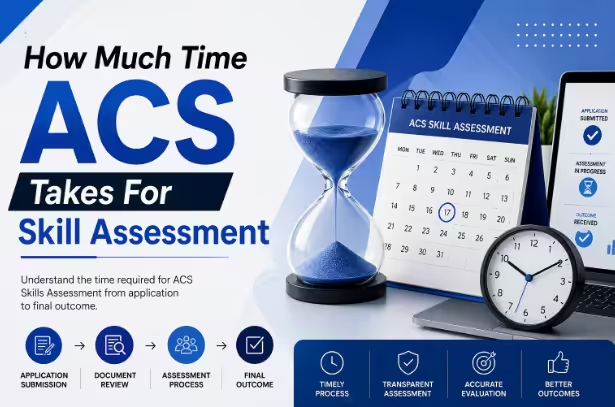
Worried about how much time ACS takes for skill assessment? It normally takes four to six weeks for standard skills assessment applications. But if you require an RPL or other documentation review, ACS will need twelve weeks.
Understand The ACS Skills Assessment Timeline Before Applying
A successful evaluation of your technology skills becomes the most important step in creating a career as a tech professional in Australia.
Careful planning is critical when managing time during migration, which leaves a lot of IT applicants asking themselves: How much time does ACS take for skill assessment?
A typical application can be processed within 4 to 6 weeks, on condition that all documents are correctly completed at the very beginning.
However, the timeframe may vary from 2 weeks to 12 weeks, depending on application procedures, preparation of documents, and the nature of the assessment process.
Familiarity with these timeline variables allows the candidates to schedule the submission of their visas without any unexpected delays.
Standard Applications Secure Swift Skill Evaluation Outcomes
The process of reviewing standard qualifications for those possessing ICT degrees usually takes about 4 to 6 weeks. The process of checking the qualifications involves an analysis of tertiary-level educational transcripts in relation to the set international educational standards to ensure course content equivalence.
Having your reference letters and transcripts in order helps the assessor to go through the workflow without having to look for other necessary files. Having your documents accompanied by English translations speeds up the process.
Candidates that comply with the submission procedure are issued an outcome letter in time, thus allowing them to complete the Expression of Interest profile submissions.
Non-Traditional Pathways Extend File Review Durations
The applicants who qualify through RPL face longer periods of assessment that take 8 to 12 weeks. This process involves the need for applicants not holding ICT degrees and those who are self-trained to prove industry expertise through extensive project reports.
These project reports go through extensive manual review by the assessors to ascertain the professional competences of the individuals against Australian ICT standards.
Engineers holding overseas qualifications should prepare an extensive CDR report for Engineers Australia migration stream to prove their technical competencies and professional knowledge against the national Australian standard.
Complete employment reference letters listing specific core ICT duties streamline the verification process.
- Two official proof of payment documents per year will help you avoid verification delays.
- Certified English translations of non-English documents will help you avoid translation delays.
- Make sure your ANZSCO code corresponds to your actual job activities.
Priority Application Tracks Accelerate Skill Evaluation Schedules
Applicants with impending Australian visa expiry deadlines within 12 weeks can apply for the fast-tracked assessment queue. Fast-tracking assessment cuts down the assessment process time to an incredible 2 to 3 weeks.
It is essential for applicants to produce official proof of impending visa expiry to enable them to be considered for fast-tracked assessment.
Submission of impeccable job documentation and crisp passport copies will help the fast-tracked process progress without any administrative hiccups.
The knowledge of the time ACS takes for skill assessment with priority status enables qualified applicants with an important advantage in meeting immigration deadlines.
Clear Reference Letters Eliminate Document Rejection Delays
Lack of proper employment references continues to be the main reason for long delays in all processing streams. In cases where assessors find that pay slips, job title information, or signed reference letters are missing, an official Request for Information (RFI) is generated.
The generation of an RFI freezes the entire process, resulting in a delay of between 2 and 6 weeks. Matching the job description to the right ANZSCO codes ensures that the file does not go into administrative hold due to a lack of proper documents.
Understanding the time ACS takes for skill assessment enables candidates to appreciate the importance of proper initial document preparation to avoid an RFI delay.
Strategic Preflight Preparation Guarantees Timely Outcomes
Providing scans of original documents in high resolution and color guarantees that the assessors will not have any breaks during their process of verifying the documents.
Engineers who are qualified abroad and want to undergo skill assessment using the regional assessors must provide their Knowledge Assessment report to demonstrate that their skill levels are consistent with Australian Accord standards.
A good file organization before the online application process will ensure that you have an easy sail during pre-screening stages.
Preparing the file properly will guarantee successful results within a stipulated period, keeping everything on track regarding the skilled migration plans for Australia.
Peak Application Volumes Temporarily Extend Processing Schedules
Increased application volumes at certain times of the year might cause an additional delay of 2-4 weeks on top of regular evaluation periods.
The increased volume of applications during the intake period, like at the end of the Australian financial year, causes a backlog in the evaluation process.
While candidates provide all necessary documents, large numbers of files will inevitably delay the verification process manually.
Knowledge about the time ACS takes for skill assessment in the peak season enables applicants to file their applications early enough to safeguard them from processing problems throughout the year.
FAQs
How much time does ACS take for skill assessment?
Standard skills assessment takes 4 to 6 weeks for those with all documents in their application. While priority processing can help in reducing the waiting period to 2 to 3 weeks due to a visa deadline, RPL assessment takes between 8 and 12 weeks.
What leads to delay during the ACS assessment process?
Lack of payment proof, unsigned employment references, uncertified translation, and confusing scanned copies of documents are some factors that lead to delays. If an RFI is issued by an assessor to get more information, it will make the assessment process stop for 2 to 6 weeks.
Can I apply for priority processing for an ACS assessment application?
Yes, you are eligible for priority processing if you have less than 12 weeks to your visa deadline. You should provide your visa deadline officially at least 2 weeks before that to get results within 2 to 3 weeks.
For how many years would an ACS skills assessment result be valid?
The validity period for the ACS skills assessment result letter is three years from the date of issue of the letter. It allows enough time for the applicant to file their EOI and complete the other stages of the Australian skilled migration visa.
Does the issuance of an RFI affect the time ACS take for skill assessment?
Yes, the issuance of an RFI will pause your application timer until you provide the requested missing files. It takes about 28 days for applicants to submit the required information.
Conclusion
With knowledge about the time ACS takes for skill assessment, IT professionals can map out their Australian migration process with ease. With prior preparation of full employment references, proper academic records, and confirmed translations, candidates normally experience routine processing results within 4 to 6 weeks.
Although some specialized processes such as RPL need long periods for assessment, keeping all documentation ready helps avoid pauses due to RFI queries. Considering realistic assessment times in your migration process will guarantee you a smooth journey to establish your professional career in Australia.